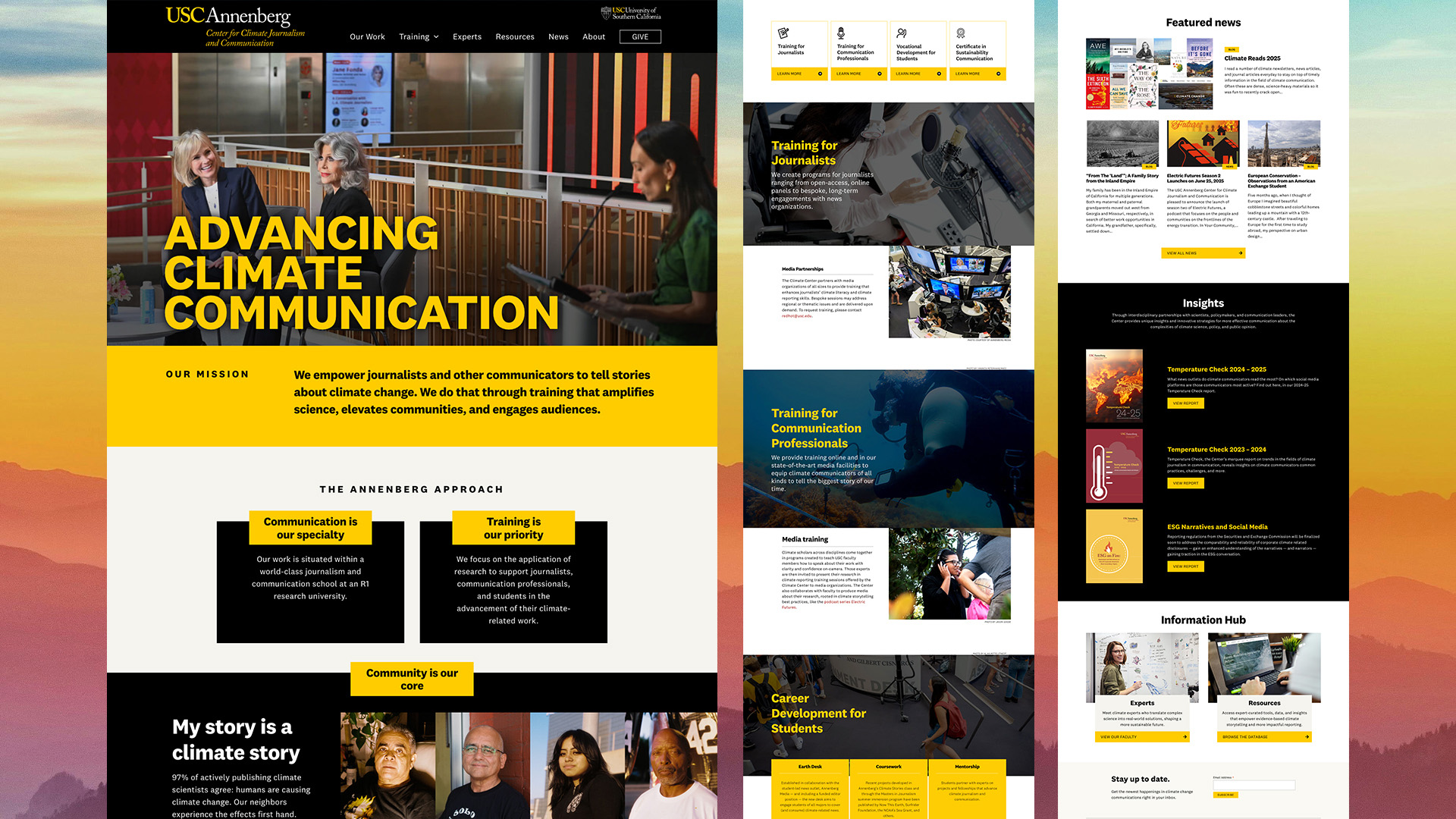
The Netty Awards recognized STAUFFER as an Honoree in Best Web Development Agency for their USC Annenberg work and the significance of that designation is much bigger than a line item. This project reframed what a launch-ready academic center website can accomplish in weeks, not months, while still meeting university standards and accessibility requirements. STAUFFER built a platform that looks like an editorial system and behaves like a product. The Center for Climate Journalism and Communication is handling frontline conversations about climate and culture and that urgency shows up in how the site works. Visitors can enroll, apply, subscribe, request a custom session, or listen to a show in the same visit. The Netty Awards recognition reinforces that higher ed websites are now evaluated on usefulness, velocity, and editorial craft, not just templates and CMS work. It is a proof point that brand governance and research rigor can live inside a system that is engineered for action.
Innovation and Differentiation
What made this work distinctive was not a single technical trick. The innovation was the three-part fuse of governance, voice, and maintainable engineering inside a five-week delivery window. Most higher ed builds struggle because creative, content, and engineering workflows are disconnected. STAUFFER collapsed those walls by translating USC Annenberg brand governance into reusable patterns that could handle real work. They kept the visual system intact but defined a voice for the Center through bold typography, intentional negative space, and a simple photo language that looked and felt human without losing scientific credibility. The modular WordPress block library translated complex publishing behaviors into repeatable components the Center’s small team could operate. There were blocks for programs, trainings, reports, research, and student stories with page templates shaped by how each of those audiences makes decisions. The resource library was built as a curated toolbox with clear routes to calls to action. All of that was governed by accessibility standards that shaped type scales, color logic, content hierarchy, and focus states. The result was a site that reads like a modern magazine and behaves like a product, but can be maintained by non-technical staff.
Measurable Impact and Success
The team defined impact up front as activation, engagement, and operational efficiency. Activation meant that a single session could move someone from interest to action. Program pages are structured to convert that interest into certificate inquiries and enrollments. Fellowship pages convert awareness into applications. Public program listings convert curiosity into RSVPs and attendance. Engagement meant that content needed to be usable, not decorative. The resource hub gives journalists and educators material they can use today, which is why repeat visits are strong. Electric Futures functions as both content and retention. Insights reports are structured to attract inbound links and sharing which drives amplification outside campus lines. Operational efficiency is where the engineering choices matter. Editors can publish without developer intervention so content stays current and cycle time stays low. The block library reduces page assembly effort which lowers maintenance cost. This is how digital work in higher ed should be judged today: not by pageviews but by actions taken, repeat engagement earned, and resources shipped without friction.
Creative Elements and Execution
The most important creative choice was using the mission to control narrative order. The homepage opens with a clear mission and the Annenberg Approach, followed by three plain language pillars that translate the Center’s role in a way a student, journalist, donor, or policymaker would understand. From there, every creative choice has a job. The Training section combines certificates, fellowships, and tailored sessions with direct exploration links, which reduces cognitive effort and moves users toward the right next step without extra explanation. The Media Projects area introduces Electric Futures with listening options on major platforms. Public Programs and Featured News keep immediacy visible between big releases. The Information Hub is designed like a newsroom utility. Experts and resources are browsable and Insights elevates marquee work like Temperature Check with direct “View Report” actions. The experience uses concise headlines, scannable summaries, and plain language microcopy that tells users what happens next. Execution is disciplined: consistent card patterns, descriptive link labels, visible focus states, and calm spacing. A sitewide subscribe invitation provides a pathway to a longer relationship after the primary task is complete. All of this is how editorial craft and product logic can work together without forcing compromise.
Overall Excellence and Industry Advancement
STAUFFER built a model others can replicate. They proved that an academic center website can present training, research, news, and media in a scannable structure that supports a lean team and still honors brand standards. Visitors can explore professional education, apply for a fellowship, request a bespoke session, subscribe, listen to media, and read flagship research from one entry point. Excellence shows up in how the site serves all three audiences at once without fragmenting the journey. The industry advancement is the template itself: a direct, action-oriented information architecture built within governance and produced with a block library that can scale as content expands. Editors publish with confidence. Visitors find what they need without translation costs. And the institution maintains credibility while increasing participation. For Best Web Development Agency, this Honoree recognition makes sense. This is a higher education web model that treats clarity, velocity, and operational efficiency as creative obligations.
About STAUFFER
STAUFFER is a digital development agency specializing in complex web systems, higher education platforms, and structured content engineering. They convert brand and communications strategy into production-ready component systems, fast. Their work focuses on clarity, maintainability, and measurable outcomes. STAUFFER is headquartered in Los Angeles and works with institutions and organizations across the United States.
About the Netty Awards
The Netty Awards are a prestigious awards program that honors top leaders and companies across various industries in the digital age. With over 100 unique categories and a longstanding track record as one of the most trusted organizations in the industry, the Netty Awards celebrate achievements in Design, Social Media, Influencers & Creators, Web, Advertising & PR, and Apps & Software. Recently featured in USA Today for their Top Agencies List, the Netty Awards are recognized as one of the most trusted agency directories for decision-makers.