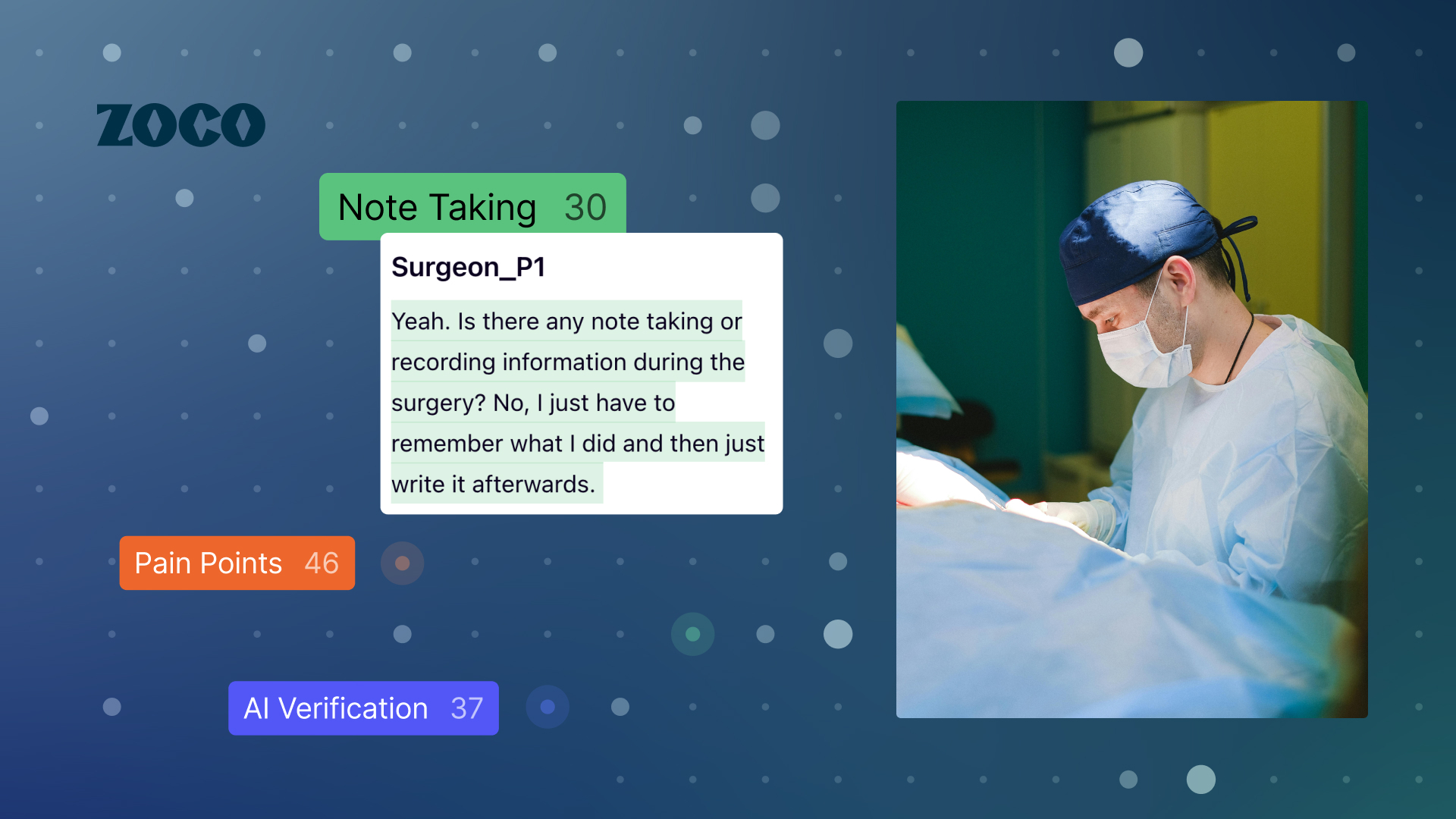
The Netty Awards have selected ZoCo Design as the Winner in Best Healthcare and MedTech UX for their work with mTuitive. This project tackled one of the most loaded questions facing healthcare product teams right now: how do you bring AI into clinical workflows in ways clinicians actually want. Instead of assuming automation was always the goal, ZoCo set out to understand how real clinicians viewed AI’s role in their daily decision-making. The result was not simply a better feature concept, but a reframing of how the product roadmap should evolve. ZoCo’s approach drove clarity inside a space that is typically noisy, hype filled, and technology-centered. Winning this category reflects more than strong product thinking. It reflects cultural fluency in a field where the stakes are life-altering, mistakes are unacceptable, and trust has to be earned.
Innovation and Differentiation
The most important differentiator in this project was a simple but overlooked question: what do clinicians actually want AI to do? ZoCo interviewed pathologists and surgeons across multiple countries and found a tension that most teams misunderstand. Most clinicians were open to AI support but they did not want an experience that was so streamlined that the rigor of their work vanished. They wanted a balance of simplicity and friction because friction is sometimes a signal of control, safety, and accuracy.
ZoCo translated that insight into a spectrum of future state design concepts. This approach allowed ZoCo to measure not only possibility but appetite. It also pushed the industry conversation away from the automation-centric model that has dominated medtech and into a more human-centered understanding of where trust is gained or lost. Many AI roadmaps skip this step and it is why adoption stalls. This work showed that adoption is not earned through capability alone, but through the psychology of clinical decision making.
Measurable Impact and Success
ZoCo embedded mTuitive’s product and leadership teams directly into research and co-creation sessions, which accelerated alignment and gave decision makers more confidence. This was not performative collaboration. It was hands-on involvement in interpretation and prioritization, which reduced time to clarity. mTuitive’s Product Manager captured this impact, noting ZoCo was thoughtfully incorporating their feedback as the work evolved. Another unexpected but valuable insight emerged around pathologist needs that extended beyond AI that newly opened value streams for mTuitive to explore. While the feature is still pre-launch, the direction has been validated, the risk has been reduced, and internal champions are already in place.
Creative Elements and Execution
ZoCo used AI prototypes inside the interviews to make the future tangible. One concept in particular tested clinical boundaries and received unanimous rejection. That moment was the turning point that set the ceiling for AI. The team also found that audiences started with very different baselines of knowledge, so, ZoCo recommended a more flexible open workflow that could serve multiple mental models while still maintaining clarity. The team also brought mTuitive’s product and engineering leaders into live Miro sessions where research was processed in real time so they could feel the reasoning unfold. That transparency built shared conviction, proving that collaboration is a skill, not a ceremony. ZoCo’s creative execution was not about visual styling alone. It was about shaping the process so valuable insights could emerge.
Overall Excellence and Industry Advancement
The AI space is flooded with what is possible but starved of what is adoptable. This project stands out because it did not chase novelty. It pursued believability. It also did not bow to the industry pressure to prove capability through maximum automation. ZoCo’s approach acknowledged that emotional and behavioral drivers are just as critical to adoption as technical sophistication. That is what elevates this work. It shows that you cannot design credible clinician-facing AI without an understanding of how clinicians think about risk, rigor, identity, and control. Many medtech teams build for what clinicians could use if they were different. ZoCo built for clinicians as they actually are. This distinction is why this project represents progress. It shows that excellence in healthcare UX is not about wow factor visuals or flashy AI. It is about helping experts make decisions they can stand behind. That is real industry advancement.
About ZoCo Design
ZoCo Design is a research-driven product design agency that specializes in turning high-stakes ideas into products that get adopted. They have deep experience in regulated spaces and are known for uncovering the human truths that drive retention and trust. They help teams build products that are not only modern and sophisticated, but grounded in how users actually behave.
About the Netty Awards
The Netty Awards are a prestigious awards program that honors top leaders and companies across various industries in the digital age. With over 100 unique categories and a longstanding track record as one of the most trusted organizations in the industry, the Netty Awards celebrate achievements in Design, Social Media, Influencers and Creators, Web, Advertising and PR, and Apps and Software. Recently featured in USA Today for their Top Agencies List, the Netty Awards are recognized as one of the most trusted agency directories for decision makers.